
Walnut Blasting and Carbon Build Up Removal
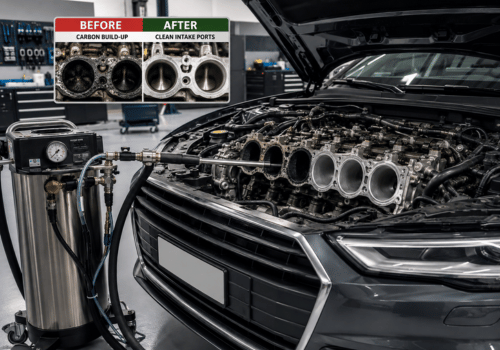
How Does Walnut Blasting Work?
Walnut blasting is when crushed up walnuts are blown into the car’s engine with an air compressor. It works like a sand blaster, except that if sand gets inside of your car’s engine, it will wreck the engine. That’s why they use crushed up walnut shells.
Basically it’s done by removing the intake manifold and blasting it with crushed walnut shells and compressed air, and blasting away all of the carbon build up so your car performs like it was supposed to.
The walnut blasting is a good way to do it, however, what we’ve found is that it often misses those hard to reach places in the engine including the valves and the rings.
The Best Way to Remove Carbon Build Up – It’s Not Walnut Blasting
We’ve found that you need to get the whole system clean for your car to drive efficiently; including the rings, the valves, the intake manifold. It’s going to require an oil change at the same time as well as the spark plugs.
Walnut blasting isn’t able to reach all of the hard-to-reach areas of the engine where the carbon is caked on. So we use a chemical carbon build up removal process that just melts all that carbon goo away. And because we’re putting that chemical into the engine and the combustion chamber and we’re getting the compression rates back up.
Intake valve after carbon build up removal.
How Much Does Walnut Blasting or Carbon Removal Cost?
Prices range from 700-$1200. It depends on the make and model of your vehicle and the size of the engine, i.e. V6, V8, etc.
How Often Does Does Carbon Need to Be Removed from your engine?
It depends on a variety of factors; Your driving habits, the quality of gas you use, how well you take care of your car…etc. Some dealers would say however, that it should first be done between 22,000 and 40,000 miles.
What are the results of carbon build up?
Loss of power which can be unnoticed because it’s a gradual loss over time, engine misfire, not specific to a cylinder, random engine misfires, check engine light codes, P0300, P301, P302.
Other symptoms of carbon build up include: Check engine light, sluggishness, extended starting times, extended cranking, cold weather startup affected.
Is your car experiencing sluggishness or any of the other symptoms of carbon build up? Or did the dealer recommend walnut blasting?
Bring it in to Virginia Auto Service for a free second opinion or contact us to get a free estimate for carbon build up removal.
Customer Amenities
The Virginia Auto Service Difference
We believe quality auto repair should come with a convenient, customer-focused experience. Our amenities are designed to simplify your visit, minimize disruptions to your day, and make caring for your vehicle easier.